
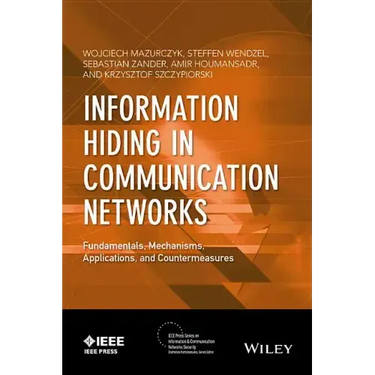

Information Hiding in Communication Networks: Fundamentals, Mechanisms, Applications, and Countermeasures - Hardcover
 Information Hiding in Communication Networks: Fundamentals, Mechanisms, Applications, and Countermeasures - Hardcover
$168.21
/
Information Hiding in Communication Networks: Fundamentals, Mechanisms, Applications, and Countermeasures - Hardcover
$168.21
/

products.product.pickup_availability.unavailable

Your payment information is processed securely. We do not store credit card details nor have access to your credit card information.


by Wojciech Mazurczyk (Author), Steffen Wendzel (Author), Sebastian Zander (Author)
Describes Information Hiding in communication networks, and highlights their important issues, challenges, trends, and applications.
- Highlights development trends and potential future directions of Information Hiding
- Introduces a new classification and taxonomy for modern data hiding techniques
- Presents different types of network steganography mechanisms
- Introduces several example applications of information hiding in communication networks including some recent covert communication techniques in popular Internet services
Back Jacket
Describes Information Hiding in communication networks, and highlights their important issues, challenges, trends, and applications.
This book provides the fundamental concepts, terminology, and classifications of information hiding in communication networks along with its historical background. Information Hiding In Communication Networks: Fundamentals, Mechanisms, Applications, and Countermeasures begins with introducing data concealment methods and their evolution. Chapter two discusses the existing terminology and describes the model for hidden communication and related communication scenarios. Chapters three to five present the main classes of information hiding in communication networks accompanied by a discussion of their robustness and undetectability. The book concludes with a discussion of potential countermeasures against information hiding techniques, which includes different types of mechanisms for the detection, limitation and prevention of covert communication channels.
- Highlights development trends and potential future directions of Information Hiding
- Introduces a new classification and taxonomy for modern data hiding techniques
- Presents different types of network steganography mechanisms
- Introduces several example applications of information hiding in communication networks including some recent covert communication techniques in popular Internet services
This book is intended for academics, graduate students, professionals, and researchers working in the fields of network security, networking, and communications.
Wojciech Mazurczyk is an Associate Professor at the Institute of Telecommunications, Faculty of Electronics and Information Technology, Warsaw University, Poland. He is also a senior member of IEEE.
Steffen Wendzel is Head of Secure Building Automation at the Fraunhofer Institute for Communication, Information Processing, and Ergonomics (FKIE) in Bonn, Germany.
Sebastian Zander is a Lecturer at the School of Engineering and Information Technology, Murdoch University, Australia.
Amir Houmansadr is an Assistant Professor within the College of Information and Computer Sciences at the University of Massachusetts Amherst.
Krzysztof Szczypiorski is a Professor of Telecommunications at the Institute of Telecommunications, Faculty of Electronics and Information Technology at Warsaw University of Technology, Poland.
Author Biography
Wojciech Mazurczyk is an Associate Professor at the Institute of Telecommunications, Faculty of Electronics and Information Technology, Warsaw University, Poland. He is also a senior member of IEEE.
Steffen Wendzel is Head of Secure Building Automation at the Fraunhofer Institute for Communication, Information Processing, and Ergonomics (FKIE) in Bonn, Germany.
Sebastian Zander is a Lecturer at the School of Engineering and Information Technology, Murdoch University, Australia.
Amir Houmansadr is an Assistant Professor within the College of Information and Computer Sciences at the University of Massachusetts Amherst.
Krzysztof Szczypiorski is a Professor of Telecommunications at the Institute of Telecommunications, Faculty of Electronics and Information Technology at Warsaw University of Technology, Poland.

