
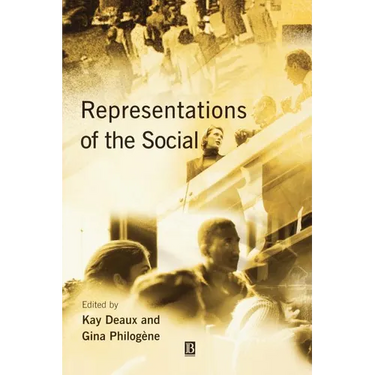

Representations of the Social: Bridging Theoretical Traditions - Paperback
 Representations of the Social: Bridging Theoretical Traditions - Paperback
$136.51
/
Representations of the Social: Bridging Theoretical Traditions - Paperback
$136.51
/

products.product.pickup_availability.unavailable

Your payment information is processed securely. We do not store credit card details nor have access to your credit card information.


by Kay Deaux (Editor), Gina Philogène (Editor)
This broad-ranging volume introduces social representation theory to a general readership, explaining how humans construct a framework of shared references which defines how we think about our world.
Back Jacket
Humans are social animals, living through interaction with each other. We construct a framework of shared references to define how we think about the world around us. Such shared references are social representations. This theoretical concept allows us to rethink the complex interaction between our individual minds and the social life by focusing primarily on socio-cultural phenomena and their integration into our common sense.
This volume brings together prominent social psychologists from the United Stages and Europe to present the major concepts and applications of social representation theory. Both content and methodological issues are raised in a series of case-study chapters. In addition, 3 key themes - social construction, social categorization, and social identification - are addressed through chapters and commentaries by social psychologists of representing different theoretical traditions and geographical locales. Covering a wide range of issues, this diverse collection will have a forceful impact on the future of social psychology.
Author Biography
Kay Deaux is Distinguished Professor of Psychology at The City University of New York. She is past president of the American Psychological Society and is author/editor of many books and journal articles.
Gina Philogène is an Assistant Professor of Psychology at Sarah Lawrence College (Bronxville, New York). She has published several journal articles in both the United States and Europe and is the author of From Black to African American: A New Social Representation (1999).

