
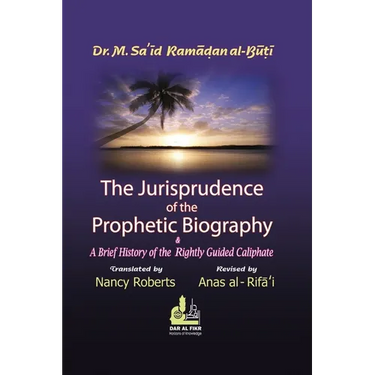

The Jurisprudence of the Prophetic Biography and a Brief History of the Rightly Guided Caliphs - Paperback
 The Jurisprudence of the Prophetic Biography and a Brief History of the Rightly Guided Caliphs - Paperback
$57.38
/
The Jurisprudence of the Prophetic Biography and a Brief History of the Rightly Guided Caliphs - Paperback
$57.38
/

products.product.pickup_availability.unavailable

Your payment information is processed securely. We do not store credit card details nor have access to your credit card information.


by Dr M. Saʿīd Ramá Al-Buti (Author), Nancy Roberts (Translator)
The Jurisprudence of the Prophetic Biography presents one of the most influential modern scholarly studies of the Sīrah of the Prophet Muḥammad ﷺ, authored by the distinguished Syrian scholar Dr. Muḥammad Saʿīd Ramaḍān al-Būṭī.
Unlike conventional historical biographies, this work examines the life of the Prophet through the lens of Islamic jurisprudence (fiqh) and ethical reflection. The author analyzes the events of the Prophetic mission not merely as historical narratives but as sources of legal guidance, moral insight, and principles governing Islamic society.
The book begins with methodological introductions that explore:
- The importance of studying the Prophetic biography for understanding Islam
- The development of Sīrah literature across Islamic scholarship
- The methodological approach required for studying the life of the Prophet
- The relationship between the Prophetic message and earlier monotheistic traditions
The main body of the work traces the chronological events of the Prophet's life, from the pre-Islamic Arabian context and the early Meccan mission to the migration to Madinah, the formation of the Muslim community, and the later consolidation of the Islamic state.
Each historical episode is accompanied by a careful analysis of the juristic lessons and ethical principles derived from the event. The author demonstrates how scholars of Islam have historically extracted legal guidance and governance principles from the Sīrah.
The volume concludes with a brief historical overview of the Rightly Guided Caliphs, highlighting their leadership, governance, and adherence to the Prophetic model.
Written in a clear yet scholarly style, the book is widely used in universities, Islamic institutes, and advanced study circles for its balanced integration of history, jurisprudence, and moral philosophy.
This work remains a foundational text for students, researchers, and readers seeking a deeper understanding of the Prophetic biography within the framework of classical Islamic scholarship and legal reasoning.

